Showing posts with label suits. Show all posts

01 January 2014

New Year's Sale


Now through midnight, Sunday, 5 January, enjoy 20% off your entire purchase in the AAW online Shop. Use discount code NEWYEAR2014 at checkout. Offer also good in the AAW Store, 249 Elm Street, 2nd Floor, Somerville, Mass. Saturday, 4 January, 10 am-2pm.

19 October 2013

Reader Questions: The Middle Ground

Reader Rob writes:

Hi Giuseppe,
I've been reading your blog for at least a couple years now and I have to say I am still mystified by suits.  I think mainly from a lack of hands on experience.  I do my best to make a decent appearance, despite being a chronically underemployed recent college grad, but I the only real occasion to wear my solitary suit is funerals. 

What really has me stumped is the fit/cut trends.  I'd really like a well fitting conservative suit, but all I seem to see is the shapeless suits all the dads wore when I was a kid in the 90s and the ultraslim/too small fit that's currently trendy.  What do I need to look for or ask for to get at that middle ground?  Can you give me a rundown of the general evolution of these trends over the decades that I'd be likely to see thrifting? 

Rob's question speaks to on of the core issues that faces those of us who favor classic clothing when out thrift shopping : the avoidance of overt trend and fashion. This is true for wearers of classic styles who shop new as well, but doubly so in the world of thrift shopping as the fashions and trends one encounters are dated and passe. The photo above is a good example, showing many of the late 1980s styles that are currently represent a large portion of whats available second hand these days. Big shoulders, low button stance, and lots of pleats. It can be tricky finding something that works for you in such circumstances, but not impossible.

Truthfully, thrift stores can contain a wide range of cuts and styles from different decades. Trim cut 1960s jackets with razor thin lapels share space with broad lapeled polyester pieces from the 1970s , big shouldered 1980s clothes, bad full cut 1990s things, and even newer stuff. And a lot, if not most of it, is bad leftover stuff that wasn't good in the first place. So how does one find the middle ground between the too tight, too short, too small look of today and the "boxy" old stuff in the thrift shop.

As with so many questions in menswear, it all comes down to finding a good tailor. When you search the thrift shops, look for suits made of quality cloth in conservative colors like navy or grey with a moderate lapel. Knowing good brands is helpful, but not necessary. Remember that a good suit is a good suit, regardless of band, as much as a brand name can trick you into accepting something of lesser overall quality. Some of the best stuff to be had in a thrift store originally came from small local men's shops you may never have heard of. Try them on until you find one that fits well across the shoulders and chest, then have a good tailor alter them, taking in the sides if necessary and removing some of that undesirable boxiness. It will cost extra, but in the end you will have a better fitting good suit for a fraction of the cost of a new one. And don;t forget, some what we now call "boxiness" may actually just be proper shape. In our current climate of too small/too tight, anything with breathing room can look baggy. Being comfortable always looks better than holding in your breath.

Above all, be persistent. Thrift shopping well takes time and determination, but the payoff, when it comes, is always worth it.


17 December 2012

Halfsies

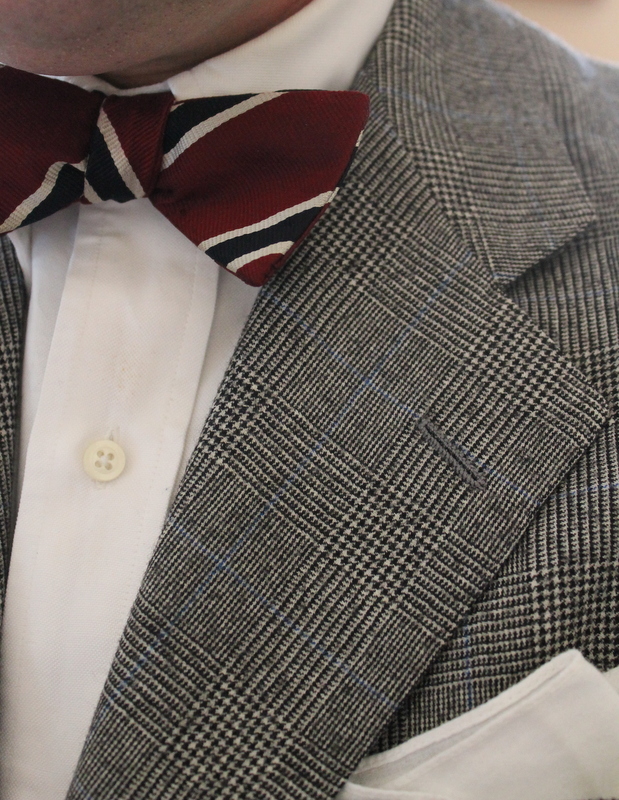
Last year, I acquired this glen check suit with light blue overcheck in a soft wool and cashmere blend by Hickey Freeman through one of my by now notorious trades with the venerable Mr. De Luca of Newton Street Vintage:
I'd wanted a good glen check suit for some time, and this one had a nice scale to it. Large enough to be prominent, small enough to appear as pale grey flannel from a distance of ten feet. I like glen checks best with an overcheck. In the old days I was certain only red would do, but blue is much more understated and workable. Brings the possibility of navy ties into the picture, despite the general black and with nature of the suit.

A suit like this is what I might call an "extra suit" in that it should really only find its place in a man's wardrobe well after he's acquired suits in navy, charcoal, and perhaps the same with some sort of stripes. For someone like me who never really needs so mach as a tie, let alone a suit, it could be better called an unnecessary frivolity. But so be it.  Oddly, in its way it's more useful to me than a navy or grey suit. Given its more casual connotations, it reads less like a business suit and as such feels more comfortable when worn for its own sake. Besides, dare I say it, it actually works as well as (gasp) two separate pieces as it does a suit. I wouldn't give such grotesquely incorrect advice lightly, so please allow me to explain.

For starters, we can see that the suit works quite well in its complete form. It is well constructed with a soft three button stance, darted front, moderate shoulders and side vents, with forward pleated trousers. This gives it just the level of formality that a suit should have.Sharp enough to be worn "in town" (as though that mattered anymore) but not so stiff as to be bound only for business meetings. In this photo, the camera is set about ten feet back, and the glen check pattern so obvious in the first photo is muted from this distance. True, the right sleeve could be a whiff longer, but let's not pick nits.

The trousers work just as well on their own with a vintage varsity cardigan in a big cut with shawl collar. A navy or black jacket would go just as well for a slightly dressier look, while a heavy black turtleneck sweater would be more casual. True, these trousers are half a suit, but glen check trousers are frequently seen alone as a single garment in their own right. As a side note, for men who actually work in businesses that require suits this look works quite well in the privacy on the office. Wear the suit on the commute, with clients, and at board meetings, keep the cardigan in the office for greater comfort while working behind closed doors.

No problem wearing a solo glen check jacket either, especially with dark grey flannels, aka "the pants that go with everything". Like the trousers, glen check jackets exist alone too, and a light grey jacket is something unexpected these days, though still quite correct. Even my nemesis agrees. A younger man could wear this jacket quite well with dark jeans and a crisp shirt, sans tie. Navy pants, never a favorite of mine, would work too. Just don't pair it with black pants. In fact, unless you're in a tux, don't wear black pants...ever.

This approach doesn't work for most suits, as the separate pieces will always look like just that, pieces separate from their counterparts. Stripes are the most glaring example, but I find a separate navy or charcoal jacket just as orphaned looking. Glen checks, being more about pattern and texture, get a pass, if you're careful and you can pull it off. Go halfsies with a suit like this, and you might get three outfits in one.


19 March 2012

Another Whiff of Spring

Pasty white ankles. I'll be damned if I'm going to wear shorts in March, but I will leave the socks at home when the temperature reaches sweaty levels. A whiff of Spring, just a whiff.

p.s. with Mother Nature threatening 80 degrees in the next few days, I've decided it's time to clear out the coats and tweed. Winter items at deep discount in the Shop right now. Click on the Sale! icon in the sidebar to go there directly.

p.p.s sorry for all the shilling lately. Back to our usual programming tomorrow.

28 December 2011

Sale!

An Affordable Wardrobe Shop is having an end of year sale!
From now until midnight Saturday, 31 December, all orders over $50 are 15% off. Use discount code NEWYEAR2012 at checkout. All orders received by the end of the sale will ship Wednesday, 4 January via USPS priority mail.