Showing posts with label ebay. Show all posts

02 January 2015

Full Circle (Thrift Shopping Edition)

My newest old new tweed...

To begin, let me say that I have missed this place. I miss sharing my thoughts on matters sartorial and other  tangential subjects however loosely related, and I miss hearing from you, O Dear Readers. What I don't miss is feeling beholden to this blog, periphery commercial interests, or for that matter the Internet in general. So without further ado, let's get back into it, as the kids say, albeit on more casual terms.Back when I announced my self imposed indefinite hiatus, I figured I would come back one way or another, I just wasn't sure how, or when. Then, a couple of weeks ago, I made an eBay purchase that was such perfect AAW fodder that I couldn't resist.

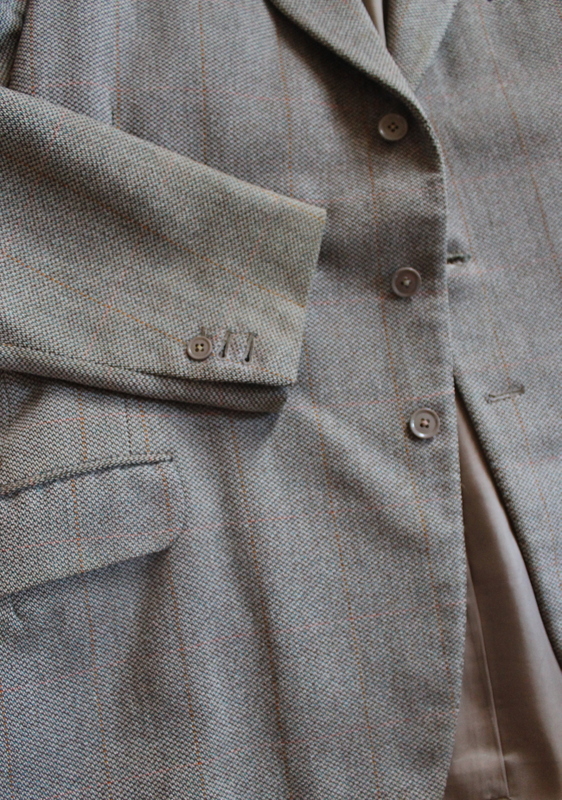
Pictured above is a massive piece of thorn proof tweed from the Andover Shop. I saw this gem listed on eBay for a mere $15. The listing had terrible photos, and stressed the "as-is' nature of the potential purchase. Given the fact that thrift shopping is always something of a gamble, and given the extremely low ante on this item, I decided there was little to lose.

Back in 2010, I found a very similar jacket at a thrift shop (of course). It was an exciting find, a real rare treat, and I wore it as often as anyone can wear a super thick English country tweed indoors in the United States in the modern times.

But I decided to sell it. Maybe it was in a fit of closet cleansing...maybe it was because I felt (as usual) that I had more clothes than decency would allow one man...maybe it was in a moment of wanting "the money" more than the jacket...or maybe it was because my then new business selling fine vintage and second hand needed the credibility that something like this would give it. I don't really remember. What I do remember is the deep pang of instant regret I felt as I taped up the box and sent it out. 

So four years later, I found what appeared to be the same jacket on eBay, for wicked cheap. When the box arrived, I vaguely recognized the name on the return address. Not only was this the same jacket, it was actually the very same one I had sold before.  

Thornproof green tweed jacket with bold orange check, via the Andover Shop, via the Salvation Army, via An Affordable Wardrobe, via eBay. The circle is complete.

29 September 2014

Cutting The Losses (An Appeal)


Back in July, I managed to "score" the suit in the above photo from ebay. It's a custom made suit by Alan Flusser, circa mid-90s. I wrote about it shortly after receiving it, using it to illustrate my "Law of Averages" theory as it applies to thrift shopping. It's made of a heavy nailhead cloth, and it's been hanging at the back of the closet in the "on deck circle", awaiting it's trip to the tailor. Every time I take it out to bring it to be fitted, it winds up getting bumped for other pending alterations. The longer I wait, the more I contemplate whether it might not be time to cut my losses on this one.

A three piece double breasted suit, seldom seen since the 1930s, is certainly not an easy garment to come by. Simply having one is something of a second hand/cheapskate gold medal. But when will I wear it? Lord knows I don't really need it. Hell, I don't really need any of this stuff. And the cost of alterations? OK, that's it, my mind is made up....
And then Tin Tin (remember him?) posts this photo, from a mid-90s era Esquire article written by none other than Alan Flusser himself. And I see such a suit in action, and I know now that I must have it...but wait a minute, no, I don't. Perhaps you see my dilemma. Or perhaps you are a more well adjusted, level headed person who is only reading this bog and others like it to marvel at the amount of time and thought that some fellows put into something so ultimately superficial and inconsequential. In any case, I appeal to you for help.

On September 19, 2008, the fellow formerly known as "Longwing" (remember him?) commented in response to this blog's very first post:

"Thrifters have too much shit. You get used to not getting exactly what you want so you tend to buy everything that even comes close."

I refuted him then, even though I couldn't help but admit that he indeed had a very valid point. It's a mild form of hoarding sickness that I have fought hard to keep in check all my life. I feel that I do fairly well, and no doubt operating a second hand clothing business does give me a convenient outlet for unwanted or no longer needed garments. But I ask you, is this not just the sort of situation old Longwing was talking about? Do I bite the bullet and pour more cash into making this suit fit? Or do I recoup my investment and get this thing into the hands of someone an inch or so taller than me? After all, I have a pair of cream colored flannel trousers already at the tailor's awaiting pick up, and a pair of cavalry twills to be dropped off, to say nothing of the dry cleaning.

Torture and anguish, thy name is a less than perfect ebay score. Thoughts and opinions greatly appreciated.

18 September 2014

Get Ready

I heard that the Farmer's Almanac has predicted an unusually cold winter this year. Not that I neccesarily put much stock in the Farmer's Almanac, butI say bring it on. I've been preparing, and I'm ready. Are you?

Currently in the closet are some old friends and some recent off season acquisitions. Left to right: Vintage Southwick heavy wool twill in hunter green; vintage wool tartan jacket (great for Bobby Burns parties); Paul Stuart brown glen check with gold and burgundy overcheck; old custom cashmere large scale glen check with blue overcheck; Andover Shop Russell plaid heavy tweed; Brooks Brothers gun club check with open patch pockets; Andover Shop moss green tweed with orange, red, blue, and lavender check; Andover Shop brown tweed with burgundy overcheck; Norman Hilton brown color fleck herringbone; three piece cavalry twill suit. All acquired through thrift shops, ebay, or trade. 

Not bad for a broke cheapskate. Persistence pays off.

p.s. Looks like we have temps pushing 80 on the way this weekend. Good thing I kept the khakis and hopsack blazer in rotation.

06 September 2014

Size Matters

As the author of this blog and a seller of second hand menswear, I am frequently asked questions regarding the measurement and sizing of old garments. In the age of the internet, more clothing than ever is bought and sold sight unseen via places like ebay and online shops like my own. In the interest of a "Reader Questions" style post, here's a guide and explanation of how sizing works and how to use measurements to successfully shop for old clothes.

Most modern clothes are sized on a tag. These measurements can be anything as vague as "alpha sizing" (S,M,L,XL) or as specific as tailored sizing (42 Reg., for example). While helpful, these sizes are best used as a guide rather than a rigid fact. In truth, there is fluidity in such sizes, and different manufacturers or brands often use the same numbers on clothes which are not physically the same size. Add to that the fact that many older and vintage clothes are either missing these tags or were never sized that way in the first place, and things can get pretty confusing. While it's helpful to know about what "size" you are, it is infinitely more helpful to know your measurements, or even just the measurements of an article of clothing that fits well. The numbers on a measuring tape are marked out in inches (or centimeters if you live anywhere but here), and there is no arguing with them.

Jackets
Most suit jackets and sport coats are sized by chest measurement and length. For example, I generally wear a 42 Regular. The number (42) refers to the circumference of the chest, in this case 42 inches, while "Regular" refers to the length of the jacket measured down the back. Generally speaking, there are five measurements to know on a tailored jacket. The chest can measured by laying a jacket flat and measuring from armpit to armpit, or "pit to pit" as you'll often read in online listing, then doubling. Bear in mind that is a differential to be considered, and few extra inches need to be left for freedom of movement. The jackets I have that I consider 42 chest measure between 22 and 23 inches across, or between 44-45 inches around. Shoulders are measured across the back from point to point. This can vary between makers and styles, but it can't be altered, so know what fits.A little variance is ok here. For example, I can wear anything from 18-19 inches in the shoulder. Length is usually listed as Short, Regular, and Long. While there is no hard rule about these lengths, I generally consider a "regular" to be about 31 inches from the bottom of the collar to the hem of the coat, short to be about 30, and long to be about 32. Again, the terms are subjective, but the numbers are not. Sleeve length is measured from shoulder to cuff, and sometimes a waist measurement will be given by measuring across the closed buttoning  point. These can be helpful, but remember too that sleeve length and side seams are easily altered. A good seller will list how much cloth there is to accommodate these alterations, or at least be able to tell you should you ask.

Trousers
Trousers are easier, with the most important measurement of course being at the waist. This is measured much the same way as the chest of a jacket, across the waistband, doubled, with room to move. For example, what I would consider a 36 waist would actually measure about 37 inches. Length is measured from the crotch to the hem down the seam. This is easily alterable in most cases and a good seller will tell how much extra cloth there is to make adjustments. If you're looking for trim or fuller cut trousers, it's helpful to know the leg opening and thigh measurement. A leg opening between 9 and 10 inches is fairly classic, with 8 inches being trim. 13-14 inches at the thigh is classic, less would be considered trim cut. If you like a trimmer look, trousers can often be tapered in a bit, but you'll need a good tailor, not just the local dry cleaner. Remember that honesty with oneself is important. You may like to say you wear a 34 waist when you really need 36. Vanity is a funny thing. It should motivate you to wear clothes that look good rather than squeeze into uncomfortable clothing that's too tight.

These things are not only helpful in the world of online shopping, but also in the physical realm. Take a measuring tape with you to the thrift store and ignore tagged sizing. If you see something you like, measure it and see how close it comes to the measurements taken from a well fitting garment you already have. With experience, you'll begin to see the relativity in tagged sizing. I personally own and wear trousers sized from 34 to 38 inches, and jackets ranging from 40 to 44 in tagged sizes, and yet they all fit. Know measurements, not your "sizes".

p.s. A Note on Blog Posts

You may have noticed that posting here has become less frequent, lately only happening once a week, usually on Saturday. As some of you may know, I have taken a writing job with the style blog at ehow.com. This job, paired with the running of both my online and brick and mortar shop, has made it difficult to keep posting here as frequently as I would like. Going forward, I will be working out a more regular posting schedule for the blog, likely twice a week. Until then keep checking in and bear with me. I truly appreciate your readership and will continue to offer the kind of content you've come to expect. Thank you.

02 August 2014

Rules of Thirfting : A Law of Averages

Thrift shopping, and living cheaply most of the time, is something of a game without rules. There are so many vagaries to contend with, and so much chance involved that the only "rule" that's true all the time is that anything can happen at any time. After a while, you learn to see the big picture as something of a law of averages.

The suit pictured above is my own most recent acquisition. Very dressy, perhaps even a whiff out of character for me, but until now I had never seen a double breasted three piece suit in the flesh. It's like a unicorn, the stuff of legend, seen only in black and white movies. Rendered in heavy but soft nailhead flannel and replete with 1930s details, made custom for someone in the mid-90s in New York by Alan Flusser, at $100, I simply couldn't resist. 

The suit will need a bit of alterations, but there's no hurry since it's a winter cloth. The alterations it does need are a little unusual though. The trousers and vest fit perfectly, and the sleeves are just the right length, which is good as it has surgeon cuffs (working buttonholes). The odd thing is that despite the trouser waist being just right, the jacket waist needs to come in, and despite the inseam and sleeves being just right, the coat needs to be shortened by a half an inch or so. The waist is an easy, common alteration, but shortening the coat will take some work and cost some money. It's not an alteration that is always possible, as you run the risk of spoiling the coats proportions, but in this case, the buttons and pockets are set in such a way that half an inch will work. The coat has side vents which are cut deep enough to take the loss of length, and because the coat is double breasted, it has corners at the front rather than the curved edges found on a single breasted coat, making this task a little easier to accomplish.

So here's how this law of averages works. While $100 may be an incredible deal for a suit of this calibre, it is well more than what I usually pay for a second hand suit. The alterations will likely cost about $100 as well. By comparison as I write this I am wearing another thrifted suit that cost $40 and needed no alterations, and my favorite all purpose navy blazer was less than $10. You simply can't expect any kind of consistency in pricing any  more than you can expect to find a specific thing on a specific day. When taken as part of an average the cost of all my clothes, this suit is cheaper even in a sense than what I paid for it. Besides, thrift shop long enough and $200 all in becomes an expensive guilty splurge on a spectacular suit, when most other people are ready to spend as much on diffusion line "Chaps Ralph Lauren" suit, or something similarly lackluster, at a place like Kohl's. Besides, there's adventure and chance involved in thrift shopping, which for the professional cheapskate is more than half the fun. And the smarmy feeling of self satisfaction that comes with knowing that you got one over on that guy who bought his cheap suit at Kohl's is kind of priceless.

27 February 2014

Rules of Thrifting : Develop Your Eye

I recently posted two rare and wonderful items for sale on Ebay, and while I like to keep the commercial aspect of things to a minimum around here, the provenance of both of these items speaks to a very important rule of thrifting that bears discussion here. Anyone can look through the obvious stuff, but it takes a seasoned pro to find things were they really don't belong, and "an eye" for this sort of thing can only come with practice and experience.


Pictured above is vintage men's dressing gown made of heavy but butter soft wool, made in England by Welch Margetson and Sons for Dunhill of New York, likely 1940s. I found this garment hidden in a rack of women's overcoats. As I passed by the rack, something about the finish of the cuffs and the piping at the lapel caught my eye, so I stopped to look. That extra minute was all it took. I might not have looked through an entire rack of women's coats, but practice has trained my eye to rest on little details that might yield a surprise result. Conversely, a rack of men's sleepwear is likely to have mostly, if not all, cheap flannel pyjama bottoms from Target and Old Navy. I'd love to keep it, and wear it with silk pyjamas and velvet slippers, but fancy house clothes and I don't mix, since I'm likely to be washing dishes, doing laundry, or some other mundane and potentially dirty task in them. Still, I hope it finds a lovely home (auction info here).

Not too much later I found this vintage flannel rowing blazer. I saw this hanging at the end of a rack of business suits in the women's department of another store. It's buttons had been replaced with some awful fake jewel buttons, and the sleeves had been "altered" by having the cuffs turned up and under about two inches and badly stitched on the inside. I took out the stitches, steamed the cuffs and sewed on some gold buttons I had laying around, which is what this jacket should have in the first place. I'm sad to see this one go, but I'm about two inches short for it and I don't think I'll be spending much time on a boat, or near one, any time soon. (auction info here).

I'm not suggesting that there's no organization in thrift shops, and certainly some are better than others, but it tends to be the more unusual garments, the ones with details that most normal people would assume are effeminate these days, that might wind up in the ladies clothes. The robe may look masculine enough in the photos I took, but its set in a very masculine context. The piping on the rowing blazer is not something common in menswear anymore, except in the most rarefied circles, and many of those folks aren't haunting the thrift shops. By the same token, brightly colored bits of silk may seem to most people like a women's accessory, but I find most of pocket squares in bins full of ladies scarves. For that matter, women's jacket styled like menswear often mix with the men's clothing in these places too.

The point here is to keep an open mind, and do what you can to develop a sharp eye for detail and imaginative shopping techniques. Sometimes the best garments are hidden in plain sight if you only just look for them.

05 December 2012

Brown in Town

Since we had such a vigorous discussion on wearing "brown in town", I thought the timing was perfect to share this gem of an item I've been sitting on for some time now.
A vintage tweed suit made of cloth so thick the garment weighs almost as much as I do. No tags, but my educated guess says this is the real deal from England, likely made in the late 1940s or 1950s. Actual country clothing, the kind of brown most definitely not intended for town, though if this were staying with me I'd be hard pressed not to wear it twice a week all Winter despite the concrete beneath my shoes.
It's dificult to do justice to thos fabric in words and pictures. A heavy tweed the likes of which is rarely seen these days, in a barley corn weave of tan and brow. A classic English overcheck in red and burnt orange runs trhough it, as well as a good dose of turquoise, yes turquoise, threads. Outstanding.
All the English details are there : side vents, structured shoulders, a nipped waist, three button cuffs with the bottom two functional, and hacking pockets with the pattern perfectly aligned.
The trousers have a high waist with a 14 inch rise, and a pretty serious fishtail back, combined with 1 3/4 inch cuffs (turn ups) and a relatively narrow 8 1/2 inch leg opening.
A button fly with a heavy steel hook at the top, forward plaets and brace buttons finish the job. The fishtail is a full four inches higher than the front waist band. This is a serious garment, a relic of a manner of dress which I see rapidly disappearing in my own lifetime.

The suit is a 42 long with a 37 waist an 31 1/2 inch inseam. If it fits you, visit the Ebay auction by way of the link in the sidebar and it can be yours. If, like me, it doesn't fit you, drool over it and wish it did. May its next owner combine it with a tattersall shirt, wool tie, high top perforated wing tip boots, a rifle, dogs, a flask of single malt and some dreary, damp weather.  Auction ends 12 December.

p.s. many new items hitting the shop soon. Stay tuned.

p.p.s. more of the usual jibber jabber to come, less shameless salesmanship.

p.p.p.s. despite what the arcane rules may state, if you have an iconoclastic streek you can wear this "in town".  I know I would.